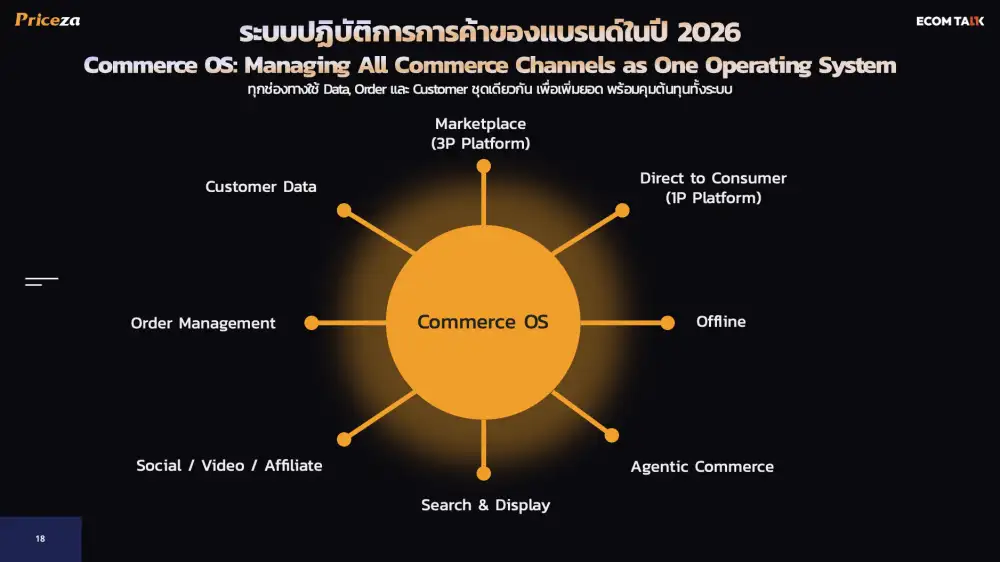
Thailand's e-commerce market will continue to grow in 2026, but success will no longer come from simply adding more sales channels. According to insights shared by Thanawat Malabuppha, CEO & Co-Founder of Priceza, during the opening keynote session "Thailand E-Commerce Trends 2026" at ECOM TALK 2026, brands must now manage e-commerce as a single operating system, a concept he refers to as "Commerce OS."
Growth Continues, but the Market Is Becoming Harder
Thailand's retail market is expected to grow by approximately 3.7% in 2026, slowing slightly from 3.9% in 2025, based on industry analysis and data from SCB EIC. Growth remains uneven across categories, with essential segments such as grocery and health & beauty continuing to expand, while discretionary categories like fashion and department stores face more cautious consumer spending amid high household debt and fragile purchasing power.
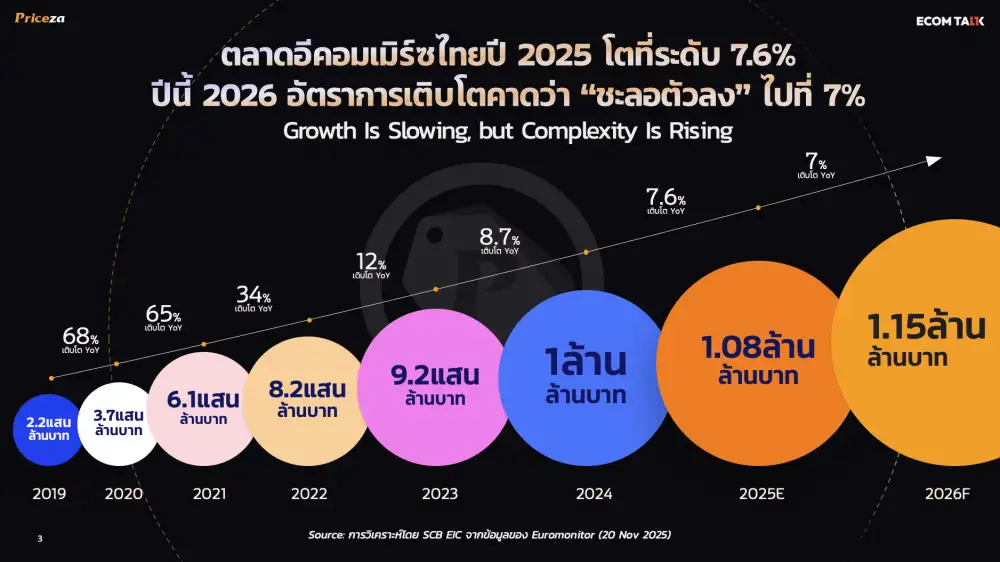
Despite these challenges, Thailand's e-commerce market is projected to reach approximately THB 1.15 trillion in 2026, growing at around 7% year-on-year and accounting for nearly 30% of total retail sales.
"E-commerce in Thailand is still growing, but it is no longer easy growth," said Thanawat. "The market will not forgive brands that operate with high costs, fragmented data, and disconnected channels."
From Multi-Channel to "Commerce OS"
Thanawat introduced Commerce OS as a framework to explain the structural shift underway in e-commerce.
"2026 is not the year to open more channels," he said. "It is the year to upgrade the entire structure. Commerce OS means managing marketplaces, brand.com, social commerce, offline stores, and emerging AI-driven channels using one shared system the same customer data, order management, fulfilment logic, and performance metrics."
Under a Commerce OS approach, channels no longer compete for budget or cannibalize each other. Instead, they are designed to reinforce one another, improving return on investment while delivering a consistent customer experience across online and offline touchpoints.
Platforms Are Becoming Commerce Infrastructure
The keynote also highlighted how major platforms are evolving beyond traditional marketplaces. Rather than serving only as transaction channels, platforms are increasingly acting as commerce infrastructure, integrating content, creators, payments, logistics, fulfilment, and financial services into a single ecosystem.
This shift, combined with the rapid rise of video commerce, live commerce, affiliate-driven creator commerce, and instant commerce, is fundamentally reshaping how brands reach consumers and scale efficiently.
Speed, Convenience, and Trust Still Drive Online Shopping
While the structure of e-commerce is changing, Thai consumer behavior remains consistent. Price, quality, and delivery speed continue to be the top drivers of online purchases, with entertainment and content playing an increasingly important role, particularly in video-led commerce models.
Same-day delivery and instant commerce are also emerging as new battlegrounds, especially for grocery, FMCG, and omnichannel retailers with dense store networks that can function as micro-fulfilment hubs.
Looking Ahead: Integration Over Expansion
The session concluded with a clear message for brands and retailers entering 2026.
"The winners in 2026 will not be those with the most channels," Thanawat said. "They will be the ones who integrate everything into a single operating system where data, fulfilment, creators, marketing, and offline stores work together as one."