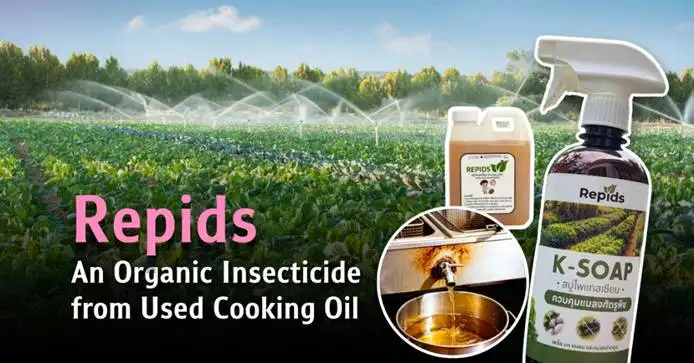
Repids, a Chulalongkorn University innovation, turns used vegetable cooking oil into a non-toxic organic insecticide, helping address pollution from grease-clogged drainage systems and improper used cooking oil management while creating an alternative organic insecticide for farmers. The technology embodies circular economy principles aimed at fostering sustainable communities and a healthier environment.
Many companies with employee cafeterias are familiar with the problem of grease accumulation, causing clogged drainage systems, despite having grease traps and filtration systems in place. Common solutions range from flushing pipes with hot water and high-pressure jetting to using chemicals or microbial treatments to break down the grease. At Chulalongkorn University, however, a different solution has emerged. An innovative technology developed by Dr. Nattapong Tuntiwiwattanapun, a researcher at the Chulalongkorn University Sustainable Environment Research Institute, transforms used cooking oil and grease waste into a non-toxic insecticide. The innovation offers a practical way to address grease waste while creating a value-added product that benefits both communities and the environment.

In 2020, Chulalongkorn University faced a problem with grease waste from campus cafeterias accumulating in drainage pipes and causing blockages. The issue stemmed from grease traps not being cleaned regularly, which reduced their effectiveness in capturing grease. Our initial solution was to convert the grease into potassium soap, a biodegradable substance that could be composted together with rain tree leaf compost. Later, after consulting with faculty members from Chulalongkorn University's Faculty of Integrated Agriculture, we discovered that the substance could also be used to control insects in organic farming plots. That led our team to develop Repids," said Dr. Nattapong Tuntiwiwattanapun, describing the origins of Repids, a liquid potassium soap-based insecticide product that is safe for plants, children, pets, and the environment.
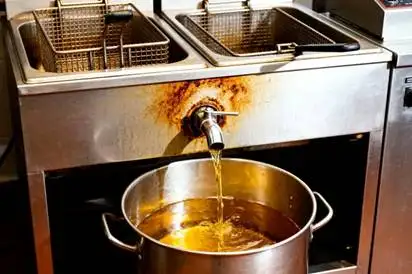
Dr. Nattapong explained that the name "Repids" combines "Re," referring to recycling and reuse, with "Lipids," the scientific term for fats. The name directly reflects the product's concept: giving new value to waste grease and used cooking oil by putting them to beneficial use.
Used Cooking Oil: A Bigger Problem Than You Think
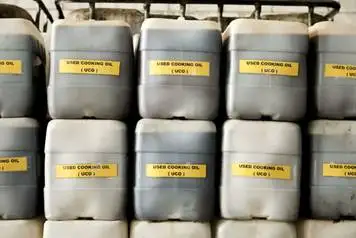
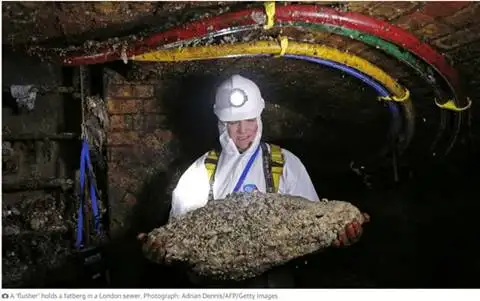
Dr. Nattapong cited findings from an international literature review showing that more than 800,000 tonnes of used cooking oil are generated in Thailand each year, yet less than 5% is collected. The remaining 95% ends up being discharged into drainage systems. "When cooking oil comes into contact with hard water containing high levels of calcium and magnesium, it reacts to form solid deposits that adhere to the inner walls of pipes. These deposits, known as 'fatbergs,' accumulate over time and eventually clog public drainage systems," he explained.
Source: The Gardian
When public drainage pipesthe city's vital arteries for stormwater runoffbecome clogged with hardened grease deposits, their capacity can be reduced by more than half and, in some cases, blocked entirely.
- The consequences can be severe. During heavy rainfall, stormwater is unable to flow through the drainage system quickly enough and instead spills onto roads and surrounding areas, leading to flash flooding or the phenomenon commonly referred to in Thailand as "water waiting to drain."
- The disruption extends beyond flooding itself. Traffic can grind to a halt, vehicles may be damaged by floodwater, and daily travel throughout the city can be significantly affected. In addition, when floodwater stagnates, or tidal surges prevent proper drainage, foul odors can rise from the sewer system and spread through nearby communities. Contaminated water carrying disease-causing pathogens may also come into contact with people, increasing the risk of skin infections and gastrointestinal illnesses.
Repids Production Process: Technology Communities Can Produce Themselves
At the heart of Repids is a process called saponification, or soap-making, in which used vegetable oils (triglycerides) are reacted with potassium hydroxide (KOH) to produce a thick liquid potassium soap.
Under normal circumstances, water and oil do not mix naturally, making soap production a time-consuming process that can sometimes result in incomplete reactions. In industrial settings, this challenge is typically addressed using a homogenizer, which provides the high-shear mixing needed to blend the ingredients effectively. Such equipment, however, is often beyond the reach of local communities.
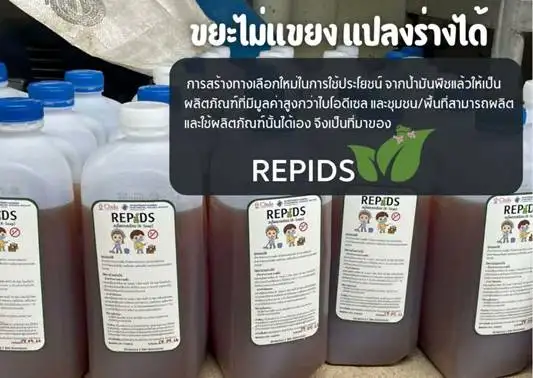
To overcome this limitation, the Repids team developed a special formulation that uses alcohol as a cosolvent to help the ingredients mix, eliminating the need for expensive machinery. The team also refined the process so that anyone can reliably produce the product using readily available chemicals by simply following the prescribed formula. Most importantly, the process generates no waste. Every ingredient added to the system is converted into the final product, making it a truly zero-waste process.
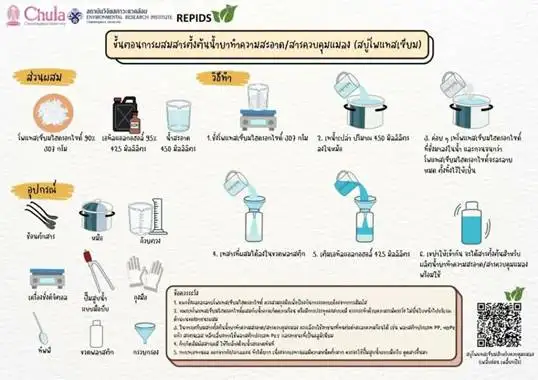
Dr. Nattapong explained that producing Repids is relatively straightforward. The key ingredients include:
- Used cooking oil - the primary source of fats and oils, which are filtered to remove food/solid residues.
- Potassium hydroxide (KOH) - the critical alkali that enables the production of liquid soap. Unlike sodium hydroxide (NaOH), which produces hard bar soap, potassium hydroxide yields a completely liquid-based soap.
- Ethyl alcohol (such as ethanol) - used as a reaction accelerator and co-solvent to help the fats and oils mix more quickly and thoroughly with the alkaline KOH solution.
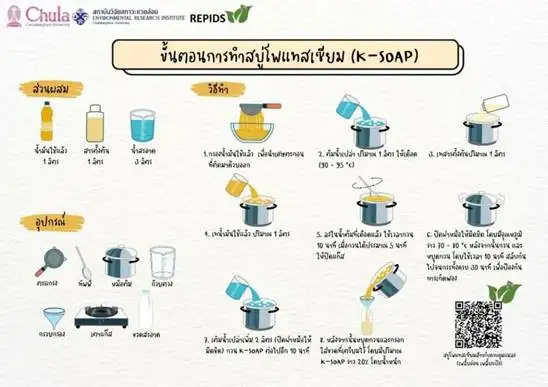
The process: The ingredients are stirred together at a constant temperature of 70-80?C for approximately one hour until a thick soap concentrate with a honey-like consistency is obtained. The concentrate is then diluted with clean water to produce the final product. One liter of used cooking oil can be converted into as much as five liters of ready-to-use solution.
Source: Repids page
The Repids production formula has been granted a petty patent. However, the Repids team has chosen to make the formula openly available so that communities and community enterprises can produce it themselves. To support adoption, the team has developed easy-to-follow infographics explaining each step of the process, while the required ingredients are inexpensive and readily available for purchase.
The Science Behind Repids: How Does It Control Insect Pests?
Many people may wonder how an ordinary soap can be effective against insects. In fact, its effectiveness is supported by a well-established scientific mechanism.
Dr. Nattapong explained, "Try observing what happens when water lands on a plant leaf or an insect. The water forms droplets and rolls off easily because both leaves and insects are coated with a layer of lipids. In nature, this protective layer helps prevent water loss, so water does not readily adhere to the surface.
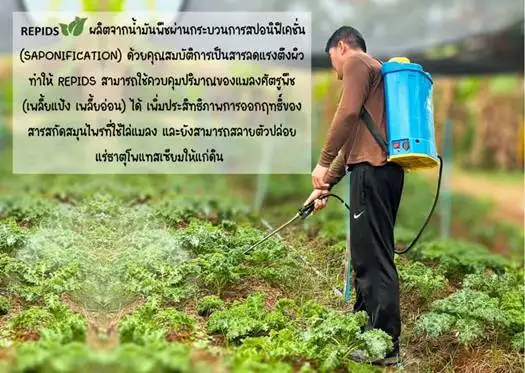
Potassium soap, however, is a surfactant - a substance that contains both water attracting and oil-attracting components. It acts as a bridge between two things that normally do not mix. When a Repids solution is sprayed onto insects, it is able to spread across and coat their bodies. This wetting effect is the key mechanism behind its ability to control insect pests."
Mode of Action: How Repids Controls Insect Pests
Its mode of action involves two key steps.
Step 1: Repids Deliver an Immediate Action
Repids liquid soap, produced from used cooking oil, naturally possesses mild surfactant properties. When sprayed directly onto insect pests - particularly small insects and sap-sucking species such as mealybugs, thrips, and spider mites - it immediately begins to affect them in the following way:
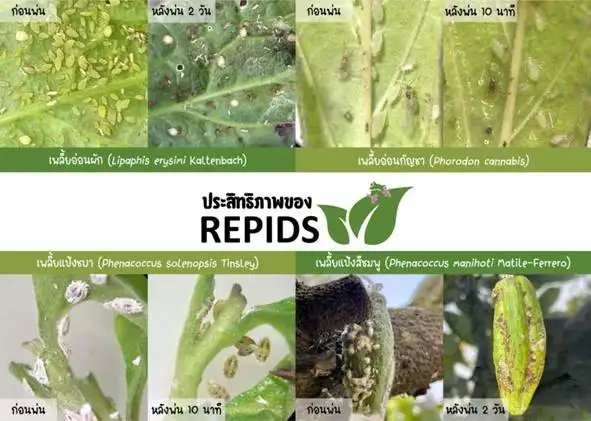
- Disrupting the Protective Coating (Cuticle Disruption): Under normal conditions, these insects are protected by a waxy or lipid - rich outer layer that helps prevent water loss. Repids works by washing away this protective coating, causing the insects to lose moisture rapidly and eventually die from dehydration. This mechanism is particularly effective against soft-bodied pests such as aphids, mealybugs, broad mites, and whiteflies.
- Blocking the Breathing Pores (Physical Hazard): Insects breathe through tiny openings on the surface of their bodies called spiracles. When a film of Repids coats the insect, it can block these breathing pores, eventually causing the insect to suffocate and die.
Because this mechanism is physical rather than chemical, it does not lead to pesticide resistance - a major challenge associated with many conventional insecticides.
Source: Repids page
Step 2: Biological Control Agents (Bt and Beneficial Fungi) Provide Long-Term Control Through the Wetting Effect
The term "wetting effect" refers to the ability to reduce the surface tension of water. Imagine placing a drop of water on a waxy leaf or on the body of an insect. The water tends to bead up and roll off rather than spread across the surface. This is a result of water's naturally high surface tension. When Repids is mixed with water and biological control agents such as Bt or Beauveria, the following occurs:
- Improved Coverage and Adhesion (Wetting): Repids reduces the surface tension of water, preventing the spray solution from forming droplets. Instead, it spreads into a thin film that thoroughly coats plant surfaces and the crevices of insect bodies. As a result, fungal spores and other biological agents are distributed more evenly and adhere to target surfaces rather than clumping together or washing into the soil.
- Gradual Growth and Colonization (Long-Term Action): For insects that survive the initial knockdown effect, fungal spores such as Beauveria can remain attached to their bodies thanks to the improved coverage provided by the wetting effect. Given sufficient moisture, the spores gradually germinate and produce hyphae that penetrate the insect's outer surface, which may already have been weakened by the soap treatment.
The fungus then develops inside the insect, causing it to become progressively weakened and eventually die within approximately 3-7 days.
Safe for Beneficial Organisms
Dr. Nattapong said that Repids liquid potassium soap meets the production standards of Thailand's Food and Drug Administration (FDA) and is also compatible with organic farming standards. It can be used as an insecticide agent or as a spreader-sticker to enhance the effectiveness of various biological control products. The product is safe for plants, children, and pets and biodegrades in the soil, releasing potassium nutrients within five days.
Importantly, Dr. Nattapong noted that "Repids does not affect bees and butterflies, which serve as pollinators. Because they are larger and able to fly away, they are unlikely to be harmed by spraying. As a result, Repids does not damage beneficial organisms, an advantage that many conventional chemical insecticides cannot offer."
Enhancing Performance with Biocontrol Agents
Dr. Nattapong explained that the original Repids formulation required a concentration of as much as 2% to achieve effective insect control, resulting in relatively high costs. The research team later discovered that the product could be used in combination with biological control agents, including:
Bacillus thuringiensis (Bt) - a bacterium widely used to control caterpillar pests, including fruit borers, loopers, and diamondback moth larvae.
- Beauveria bassiana - an entomopathogenic fungus commonly used to control sap-sucking insect pests such as mealybugs, thrips, and whiteflies.
- The result: The concentration of potassium soap can be reduced by more than 100-folds, from 2% to just 0.02%, because only its wetting properties are needed to improve the distribution and adhesion of the biological control agents. There is no longer a need for a thick soap film to directly control insect pests. This significantly lowers production costs for farmers while maintaining effectiveness.
Source: Repids page
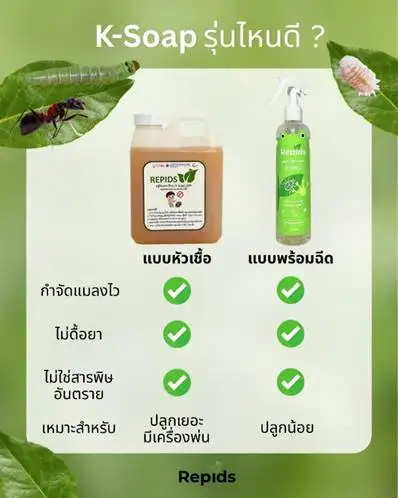
These biological control products are widely available through online marketplaces and social media channels, including Shopee, Lazada, LINE Official Accounts, and Facebook. Prices vary depending on the product type and quantity.
- Ready-to-use household spray (300 mL): 129 baht
- Concentrated formulation for intensive farming (2 liters, yielding 20 liters of spray solution): 199 baht
Limitations of Repids
Repids is most effective against slow-moving, soft-bodied pests such as aphids, mealybugs, broad mites, and immature whiteflies. However, its effectiveness is significantly reduced against:
- Hard-bodied insects, such as beetles.
- Fast-flying insects, such as cockroaches and flies, because the product must come into direct contact with the insect to be effective. If the insect escapes before being sprayed, it will not be affected.
- Armyworms in their later larval stages.
- Stem borers and soil-dwelling pests remain difficult to control using this approach.
Repids and the Circular Economy
Dr. Nattapong uses a simple term - "being frugal" - to explain the concept of the circular economy, which emphasizes making the most efficient use of resources throughout a product's entire life cycle, from design to end-of-life management. It is about more than simply recycling waste. The Repids team has applied this concept throughout the entire value chain:
- Raw materials: Used cooking oil collected from local communities, which would otherwise be discarded or become a source of pollution.
- Production: The process is designed so that communities can manufacture the product themselves, eliminating the need to transport materials outside the area. Moreover, there is no waste generated from this process.
- Application: The finished product is used in agricultural plots within the same community based on the "Local Waste for Local Use" concept.
- End of life: Potassium soap is nearly 90% biodegradable. As it breaks down, it releases potassium into the soil, providing nutrients that can benefit plant growth.
Long-Term Vision: From Soap to Ecosystem Management Technology
Dr. Nattapong said that the ultimate goal of Repids is to develop technologies that help address challenges related to soil resilience and water quality through the principles of the circular economy.
"Our strength lies in research and development (R&D)," he said. "In the long term, the Repids team aims to develop technologies for managing insect pests in accordance with organic farming standards. These technologies will then be transferred to community enterprises, regional Rajabhat universities, and original equipment manufacturers (OEMs) so they can be produced and applied locally."
Partnering with Business: The Next Step for Repids
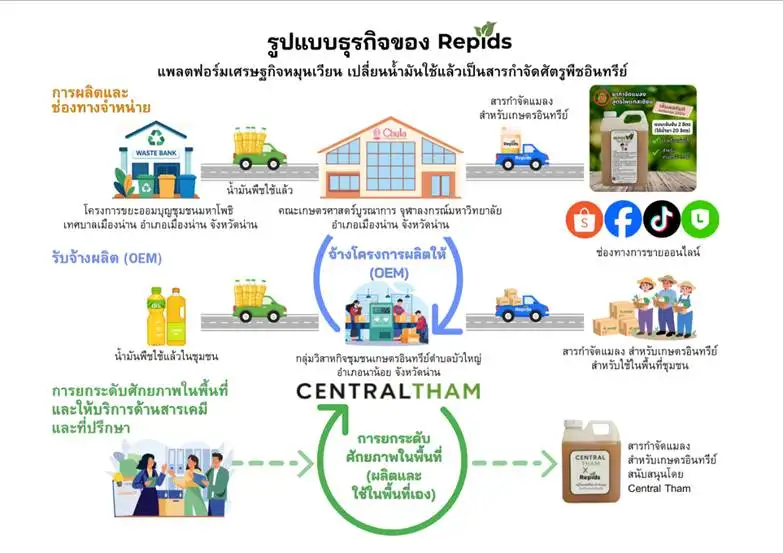
The Repids team's latest collaboration is with Central Tham, the corporate social responsibility (CSR) arm of the Central Group, which supports organic farmers in Nan Province and other areas across northern Thailand.
Dr. Nattapong explained the partnership model: "The Repids team will conduct site assessments, evaluate local used cooking oil collection systems, help establish collection and production processes, and transfer potassium soap production technology to community enterprises in the area. The communities will then use the products they manufacture in their own agricultural plots.
"At the same time, Central Tham will purchase agricultural produce from these communities, with Repids serving as part of the assurance that the crops are genuinely free from chemical pesticides."
Farmers' Appreciation Keeps the Repids Team Moving Forward
Finally, Dr. Nattapong reflected on what motivates the Repids team to continue developing and improving the innovation: "Turning research into a marketable product takes a tremendous amount of time, effort, and investment. There have been many occasions when we felt discouraged and considered giving up. But whenever a farmer tells us that our product has helped them and improved their quality of life, it gives us tremendous encouragement. It makes us want to keep going and make it even better."
Those interested in learning more about Repids or contacting the team can visit: https://linktr.ee/Repidsofficial
Continue reading a full article on the website: https://www.chula.ac.th/en/highlight/419847/
Chulalongkorn University has been ranked Thailand's No. 1 university for the 17th consecutive year (since 2009) in the newly released QS World University Rankings 2026. The university is ranked 221st in the world and places among the world's Top 100 in two key indicators: Academic Reputation (89th) and Employment Outcomes (64th).