
depa revealed the results of the midterm assessment of the Digital Economy Promotion Master Plan Phase 2, conducted in collaboration with the Fiscal Policy Research Institute Foundation. The assessment indicates that while Thailand has successfully built a solid digital infrastructure in the plan's early stage, a faster policy recalibration and strategic adjustment are required to keep pace with rapid digital change.
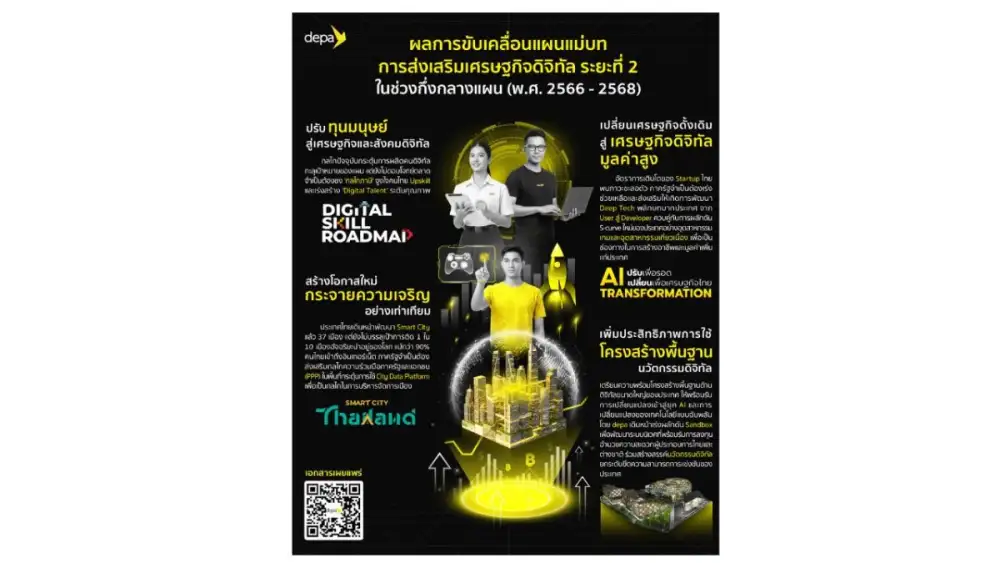
Ms. Kasama Kongsmak, Acting Senior Executive Vice President of Digital Economy Promotion Agency (depa) stated that the midterm assessment of the Digital Economy Promotion Master Plan Phase 2 (2023-2027) underscores the need to refine Thailand's digital economy and society development strategies to ensure the achievement of intended outcomesparticularly in terms of qualitative impactamid swift technological disruption. The assessment proposes four key strategic directions as follows:
Strategy 1: Developing High-Quality Digital Workforce
Although significant progress has been made in enhancing digital skills among the general population, depa has adopted a more proactive approach to address rapid technological change. The focus is now on developing professional-level digital talent, particularly in advanced AI-related fields, alongside establishing systems to monitor workforce quality outcomes.
The assessment also recommends the introduction of additional tax mechanisms, especially for individuals, to incentivize large-scale upskilling. Furthermore, greater emphasis should be placed on supporting skilled senior citizens through continued employment opportunities, as well as promoting upskilling, reskilling, and new skill development to enable other elderly groups to re-enter the labor market.
Strategy 2: Transforming the Traditional Economy into a High-Value Digital Economy
This strategy focuses on supporting SMEs, farmers, and local communities in adopting digital technologies to enhance productivity and economic resilience. The assessment calls for the acceleration of large-scale economic transformation through tax incentives and stronger support for startupsparticularly Thai-owned deep tech firmsalongside encouraging intellectual property and patent registration.
Additionally, there is an urgent need to promote the digital content industry as a new targeted industry. This includes advancing the Game Industry Promotion Act to elevate the game industry and related sectors, create new career opportunities, and generate new tax revenue sources. Support for Thai digital platformsboth in terms of market access and fundingis also essential to enhance competitiveness against multinational platforms and drive the national digital economy forward.
Strategy 3: Creating New Opportunities and Promoting Inclusive Growth
The development of Smart Cities remains a structural challenge, requiring a coordination between the public sector, private sector, and citizens. The assessment stresses that future urban development should increasingly rely on spatial and data-driven planning to ensure more effective budget allocation aligned with the specific economic potential of each locality.
The assessment also highlights the importance of expanding Public-Private Partnership (PPP) models to mobilize private-sector expertise in the delivery of digital public services, supporting Thailand's ambition to rank among the world's most livable smart cities. In parallel, improving technology accessparticularly within the industrial sectorshould be driven through concrete use cases that clearly demonstrate the business value of digital adoption. Continued efforts to enhance digital literacy, especially among vulnerable groups, remain essential to ensuring inclusive access to digital services and economic opportunities nationwide.
Strategy 4: Developing Digital Infrastructure
Although Thailand has made notable progress in digital infrastructure developmentmarked by initiatives such as the establishment of the Big Data Institute (BDI) and VISAI AI as foundational components of the national AI ecosystemthe assessment notes that additional institutional mechanisms are needed to further stimulate innovation.
The government must develop infrastructure that fosters an ecosystem capable of attracting foreign investment and technology transfer, thereby strengthening the country's overall digital competitiveness.
"The assessment of the Digital Economy Promotion Master Plan Phase 2 has led to improvements in operational mechanisms to ensure the achievement of both quantitative and qualitative targets. It also provides critical input for the development of the Digital Economy Promotion Master Plan Phase 3, which aims to transform Thailand from a digital technology user into a digital technology creator and developer. This shift will enhance Thailand's global competitiveness and enable the country to respond a rapid technological change," said the depa's acting SEVP.
All details and report of the assessment on the Digital Economy Promotion Master Plan phase 2 (2023-2027) are available at: https://www.depa.or.th