Study Across Six Nations Finds Cost Pressures Persist into 2026 as Southeast Asians Turn to Mental Wellbeing
Southeast Asia faced a convergence of economic, employment, and health pressures in 2025, according to a new regional survey by Milieu Insight that highlights widespread cost-of-living stress alongside low confidence in government support. As the region moves into 2026, the findings point to growing pressure on institutions, employers, and brands to respond to a public that is increasingly self-reliant but stretched.
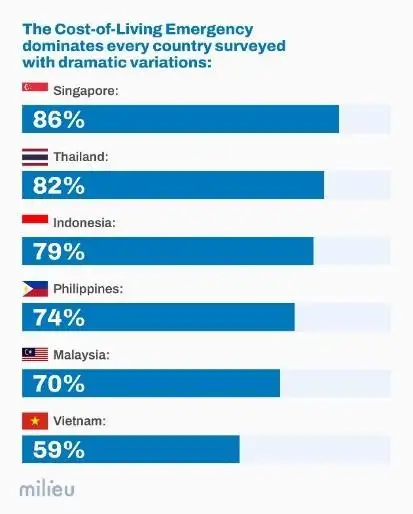
The comprehensive study of 3,000 respondents across Singapore, Thailand, Malaysia, Indonesia, Vietnam, and the Philippines shows that affordability dominated public concern during 2025. On average, 75% of Southeast Asians identified the cost of living as a key national issue, making it the most pressing challenge across all six markets surveyed. Concern was highest in Singapore (86%), followed by Thailand (82%), Indonesia (79%), the Philippines (74%), Malaysia (70%), and Vietnam (59%).
The data suggest this is not a short-term inflation spike. Cost pressures are reshaping household behaviour and priorities, and are increasingly linked to trust in the institutions meant to help people cope. Despite policy interventions introduced across the region, confidence in government effectiveness remained limited. Among respondents who cited cost-of-living pressures as a concern, only 39% said government incentives or assistance helped them cope meaningfully in 2025, pointing to a persistent gap between policy measures and lived experience.
The Triple Crisis: Cost, Jobs, and Health Collide
The findings show that Southeast Asians navigated a convergence of intersecting vulnerabilities during 2025, with rising prices, employment uncertainty, and health-related anxieties reinforcing one another and compounding household stress.
Affordability pressures dominated sentiment in every market surveyed, though intensity varied sharply by country. These pressures translated into tangible trade-offs for households, with respondents prioritising essential spending on food, transportation, utilities, healthcare, and education.
Housing affordability added a further layer of strain, particularly in more urbanised and rapidly developing markets. Nearly half of Singaporeans (47%) and 43% of Vietnamese respondents identified access to affordable housing as a major concern in 2025. These pressures risk widening inequality and delaying key life milestones, particularly for younger households entering housing and labour markets under prolonged strain.
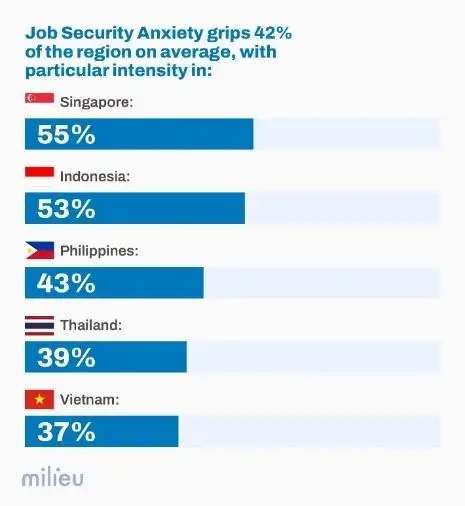
Employment insecurity further intensified this sense of vulnerability. On average, 42% of Southeast Asians reported concerns about job stability during the year. Anxiety was highest in Singapore (55%) and Indonesia (53%), followed by the Philippines (43%), Thailand (39%), and Vietnam (37%). The findings suggest labour market uncertainty was not confined to informal work or emerging economies, but reflected broader concerns around wage growth, automation, and the sustainability of existing employment models. For employers entering 2026, job security, wage progression, and psychological safety may become as critical to retention as compensation itself.
Health-related concerns also remained elevated. Across the region, 42% of respondents cited health as a source of anxiety in 2025, rising to 52% in Singapore. Rising healthcare costs emerged as a key driver. In Singapore alone, 51% identified medical expenses as a major national issue, underscoring the growing tension between rising healthcare costs and public expectations of accessible care across both developed and emerging markets.
Dissatisfaction with government support was most pronounced in the Philippines, where 59% said assistance did not help them manage rising costs in 2025, followed by Indonesia (54%), Thailand (46%), and Malaysia (46%). Even in Singapore, often viewed as a benchmark for policy intervention, 40% of respondents remained unsatisfied. The results point to a widening perception gap between policy intent and lived experience a challenge likely to shape public sentiment and trust into 2026.
The Rise of Mental Resilience Across Southeast Asia
Against this backdrop of sustained economic and social pressure, the study identifies a widespread shift toward personal mental wellness that gained momentum during 2025. Rather than a reaction to crisis alone, mental wellness increasingly emerged as a form of personal resilience amid prolonged uncertainty.
Seven in ten Southeast Asians (71%) reported actively working to better understand their own mental health during the year. Engagement was highest in Thailand (86%), followed by the Philippines (82%), Malaysia (80%), Vietnam (76%), Indonesia (57%), and Singapore (62%).
In addition, 67% of respondents sought out information or education related to mental health through online resources, courses, or learning materials. While only 21% of Southeast Asians on average cited mental health as a top national issue, individual action rates were substantially higher. This gap suggests that mental wellness has become normalised as part of everyday self-care rather than viewed solely as a policy or crisis issue.
"Across Southeast Asia, people are under pressure, but they're not standing still," said Sundip Chahal, CEO of Milieu Insight. "When support doesn't land, households adapt fast. We're seeing mental wellbeing move into the mainstream as a practical way people cope. In 2026, the organisations that respond to these shifts will earn trust, and the ones that don't risk being left behind."
A Region at a Crossroads
The study paints a complex picture of Southeast Asia in 2025. Affordability pressures, employment uncertainty, and health-related anxieties weighed heavily on households across the region, while confidence in government solutions remained limited.
As Southeast Asia moves into 2026, the findings suggest that the legacy of 2025 will not be defined solely by economic strain or policy gaps, but also by how individuals adapted. Increasingly, Southeast Asians are turning inward to build resilience and prioritise mental well-being amid prolonged uncertainty. How governments, employers, and brands respond to this shift may define public trust and social stability in the years ahead.