Perceived safety is higher in some cities, yet many women still restrict their movements and daily activities
Milieu Insight, a leading consumer research and data intelligence company, has released a new regional study surveying 3,000 women across six Southeast Asian capital cities Singapore, Bangkok, Hanoi, Jakarta, Kuala Lumpur, and Manila, examining how safe they feel in daily life, the precautions they take, and how digital safety shapes their participation at work and in public spaces.
The findings show that women's perceptions of safety vary widely across the region, with Singapore reporting the highest share of women who feel "very safe," followed by Hanoi and Jakarta.
Perceived Safety Varies Across Southeast Asia's Capital CitiesWhen measuring the percentage of women who feel "very safe" in their daily lives, the rankings are:
- Singapore - 31%
- Hanoi - 26%
- Jakarta - 19%
- Bangkok - 9%
- Kuala Lumpur - 9%
- Manila - 7%
The gap between cities where women feel most and least safe is strikingover four times larger between Singapore and Manila. Yet perceived safety does not tell the full story. Women across Southeast Asia are widely adjusting their daily routines due
to safety concerns, even in cities with relatively high perceived safety.
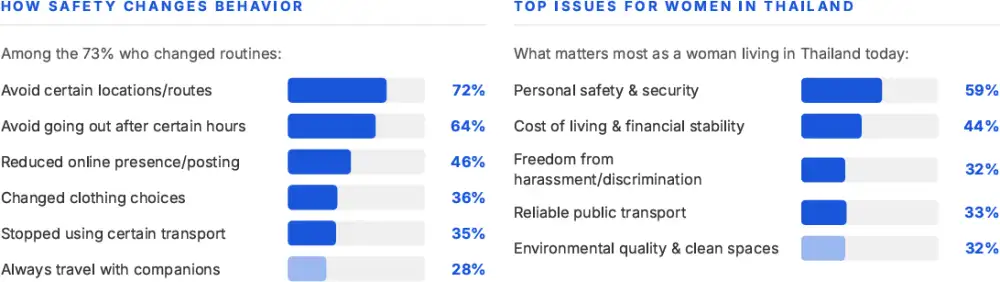
In Kuala Lumpur, 82% of women have changed their behaviourthe highest in the region, despite having one of the lowest "very safe" ratings. In Manila, 81% report altering their routines, with 24% making significant changes; 69% avoid going out after certain hours and 65% avoid specific locations, making it the most restricted city in the study.
In Jakarta and Hanoi, 76% of women have adjusted their behaviour, with 66% of women in Jakarta avoiding going out after certain hours. Bangkok follows closely, with 73% changing their routines and 72% avoiding certain locationsthe highest recorded rate of location avoidance. Even in Singapore, where 40% of women report changing their behaviour (the lowest in the region), the paradox is clear: perceived safety frequently coexists with self-imposed restrictions.
Digital Harassment: A Growing Crisis Across SEA
The study reveals alarmingly high rates of online harassment, impacting women's work and public participation. In Hanoi, 61% of women report experiencing at least one form of online harassment in the past 12 months. The most commonly reported experiences include persistent online contact or stalking (22%), doxxing (22%), and impersonation or fake profiles (20%). Jakarta follows at 48%, including 11% affected by deepfakesdouble Singapore's rate. Kuala Lumpur, Manila, Bangkok, and Singapore report 47%, 44%, 43%, and 26%, respectively.
Digital harassment carries severe career and mental health consequences across all six cities:
- Jakarta: 64% limit what they post online; 20% have withdrawn from networking or career opportunities
- Manila: 63% restrict online sharing; 36% report anxiety, depression, or sleep problems
- Hanoi: 62% self-censor; 42% have stopped participating in public discussions entirely; 24% avoided professional networking opportunities
- Bangkok: 49% limit online posting; 24% report mental health impacts
- Kuala Lumpur: 49% restrict what they share online; 15% have withdrawn from career opportunities
- Singapore: 35% limit online presence; 9% have withdrawn from networking
Up to 31% of women across cities report considering leaving social media entirely. This digital chilling effect may limit participation in entrepreneurship, thought leadership, and professional networking, with potential implications for women's long-term economic participation.
Workplace Burdens: Jakarta and Hanoi Face Systemic Challenges
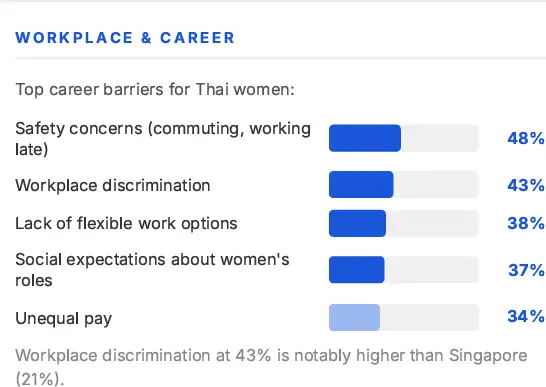
Workplace conditions vary sharply across cities, revealing systemic barriers to career advancement. Women reporting no workplace issues: Singapore 31%, Kuala Lumpur 30%, Bangkok 27%, Manila 26%, Jakarta 26%, and Hanoi 18%. This shows that up to 82% of women in some cities face workplace challenges.
In Jakarta, multiple barriers combine to create challenges: 52% cite lack of flexible work options, 43% face family caregiving responsibilities, and 43% have safety concerns around commuting or working late. Hanoi faces "caregiving pressures," with 56% reporting family caregiving responsibilities, 49% concerned about safety, and 43% lacking flexible work options.
The pressure to manage both work and domestic duties is most pronounced in Hanoi (36%), followed by Bangkok (29%), Jakarta (26%), Manila (24%), Kuala Lumpur (23%), and Singapore (22%). Pay discrimination compared to male colleagues remains significant, highest in Hanoi (21%), followed by Singapore (15%), Jakarta (13%), Kuala Lumpur (11%), and Manila (7%).
When up to 52% of women cite inflexibility as a career barrier, and up to 51% cannot work late due to safety concerns, career progression may be affected, with potential implications for the region's future talent pipeline.
Trust in Government and Institutional Confidence Varies Dramatically
Women's trust in governments to prioritise their needs shows dramatic differences across cities. When asked whether city infrastructure actively supports women's safety and mobility through thoughtful design, lighting, safe walkways, and ongoing programs, those who "strongly agree" are: Hanoi 23%, Jakarta 23%, Bangkok 23%, Singapore 18%, Kuala Lumpur 11%, Manila 9%.
Trust in local or national government to make decisions reflecting women's needs also diverges sharply. Those reporting "a great deal" of trust: Hanoi 21%, Singapore 16%, Jakarta 14%, Bangkok 8%, Kuala Lumpur 8%, and Manila 6%. Conversely, those reporting "not much" or "no trust at all": Manila 23% (highest distrust), Bangkok 17%, Jakarta 15%, Kuala Lumpur 13%, Hanoi 7%, and Singapore 4%.
Low institutional trust correlates directly with underreporting of harassment and violence: 52% of Bangkok women believe "nothing will be done" if they report; 46% of Manila women feel reporting is futile, with another 46% fearing they won't be believed; 46% of Jakarta women believe reporting is ineffective; and 44% of Singapore women fear retaliation. When systems meant to protect women fail, cycles of vulnerability persist.
"Across Southeast Asia's capitals, many women feel 'safe' because they have learned to avoid risk, but that is not freedom," said Cindy Pang, SEA CEO at Milieu Insight. "Cities, employers, and platforms can do more to create a conducive ecosystem where women can participate safely in everyday life while building their careers and raising their families with confidence."