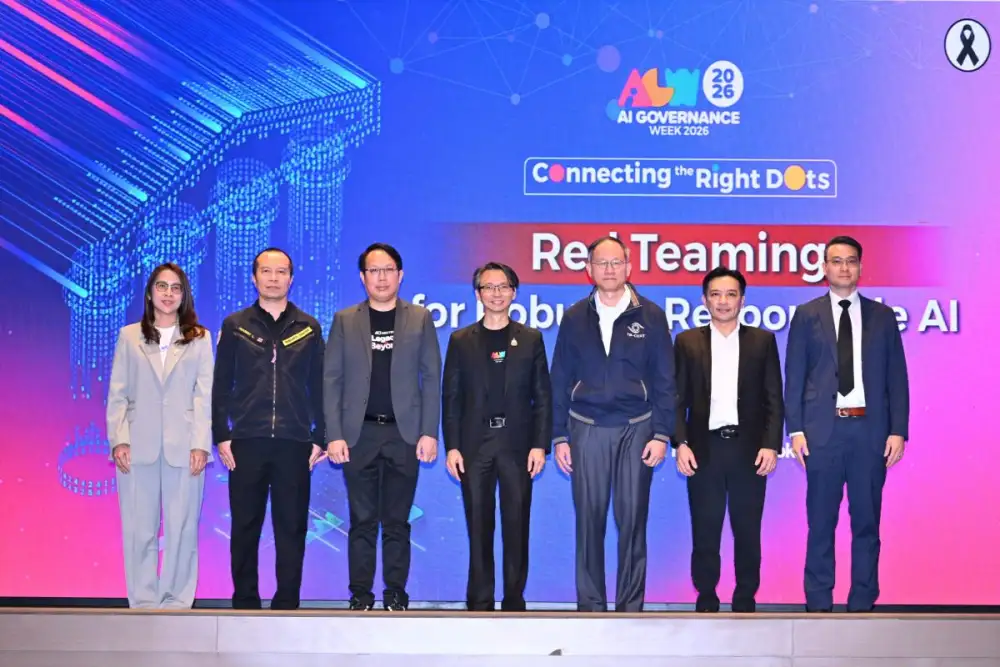
The Electronic Transactions Development Agency (ETDA), under the Ministry of Digital Economy and Society, through the AI Governance Center (AIGC), in collaboration with the National Electronics and Computer Technology Center (NECTEC), the Thailand Banking Sector Computer Emergency Response Team (TB-CERT), and the National Cyber Security Agency (NCSA), convened "Red Teaming for Robust and Responsible AI" as the closing highlight of AI Governance Week 2026 (AIGW 2026) at Mandarin Hotel Bangkok.
The forum brought together policymakers, regulators, banking institutions, technology companies, cybersecurity experts and AI safety specialists to explore how AI systems can be tested, challenged, and strengthened before being deployed in real-world services. With AI and Large Language Models (LLMs) increasingly being adopted in financial services, the event focused on identifying hidden risks, blind spots and vulnerabilities that could affect safety, privacy, fairness, reliability and public trust.
A key highlight is the Thailand Banking AI Red Team Challenge 2026, Thailand's first AI red teaming challenge in the banking context. The competition is designed to simulate real-world testing of banking AI systems to identify potential risks, weaknesses, and vulnerabilities, while laying the foundation for practical AI Governance and AI Safety mechanisms in the financial sector.
Dr. Chaichana Mitrpant, Executive Director of ETDA, said AI is no longer simply a tool for improving efficiency. It is becoming part of critical processes across public services, data analysis, decision support, and financial services, all of which involve sensitive information, people's rights, and public confidence. For this reason, AI Governance cannot remain only at the level of policies, principles, or written guidelines. It must be supported by practical mechanisms that can test whether AI systems are safe, trustworthy, fair, and resilient enough to handle potential risks before they are put into real use.
Throughout AIGW 2026, ETDA and its partners connected key dimensions of AI Governance, from global governance principles and AI Ethical Impact Assessment (EIA) to organizational readiness, AI regulation, education, AI safety, and the use of AI in critical sectors. The final-day focus on AI Red Teaming added another essential layer: proactive testing that helps organizations detect blind spots before they become real-world risks.
One of the major challenges of AI is that some risks may remain hidden during the design, development, or initial testing stages. Once AI systems are deployed, these blind spots can have broader impacts on users, organizations, and society, ranging from cybersecurity and personal data protection risks to unfair outcomes, inaccurate responses, and a loss of trust in AI-enabled services.
AI Red Teaming offers a practical way to challenge AI systems through simulated scenarios, behavioral testing, and vulnerability discovery. It helps organizations understand how AI may behave under pressure, where safeguards may fail, and what improvements are needed to make AI safer, more reliable, and more accountable.
The Thailand Banking AI Red Team Challenge 2026 was divided into two tracks. Track A: Banking AI Risk Intelligence tested AI from the perspective of general users, with participants interacting with a simulated banking AI chatbot to identify behaviors that may conflict with AI ethics principles. Track B: Capture the Flag (CTF) focused on technical vulnerability testing, where participants attempted to prompt AI systems to reveal protected or confidential information known as a "flag."
Dr. Chaichana noted that choosing the banking sector as the starting point for this AI Red Teaming initiative is highly significant, as the sector handles sensitive public data, has broad economic implications and depends on a high level of trust. The challenge was therefore not only a competition, but also a way to build knowledge, develop practical guidelines, strengthen AI Red Team capabilities, and foster collaboration among government, industry and academia.
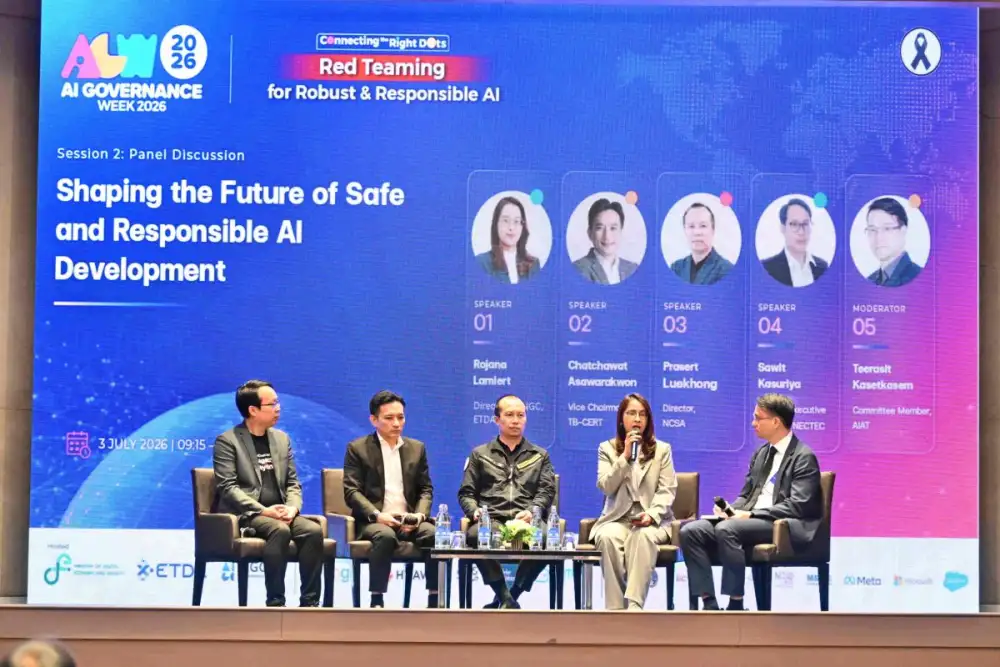
In addition to the competition, the event featured discussions with leading Thai and international experts, including the panel "Shaping the Future of Safe and Responsible AI Development" with representatives from ETDA, TB-CERT, NCSA, NECTEC and AIAT, as well as "AI Safety in Practice: Lessons from the Frontlines" featuring Microsoft, Google, Huawei and IMDA Singapore.
The program also highlighted the importance of building Trustworthy AI through keynotes by IMDA Singapore and Google, focusing on how responsibility, safety, guardrails and red teaming can be embedded into AI products and services from the outset. Another session, "Ensuring AI Safety in Products: LLM Benchmarking in Practice," brought together Thai Life Insurance, TRUE and NECTEC to discuss how LLMs can be tested and benchmarked for accuracy, safety and fairness before real-world deployment.
The day concluded with the AI Red Teaming Awards Ceremony, recognizing the teams that demonstrated outstanding ability to identify AI risks, weaknesses, and vulnerabilities. Insights from the challenge will support the development of benchmarks, risk assessment approaches, and AI testing standards that can be applied in the financial sector and expanded to other sectors in the future.
Over the five days of AIGW 2026, held from 29 June to 3 July 2026, the collaboration among public, private, academic and international partners reflected the strength of Thailand's AI ecosystem and the country's growing commitment to responsible AI adoption. It also underscored ETDA's role, through AIGPC, in moving AI Governance from principles to practice and positioning Thailand as a regional hub for trustworthy, safe and responsible AI. Follow more highlights and updates from AIGW 2026 on the ETDA Thailand page.