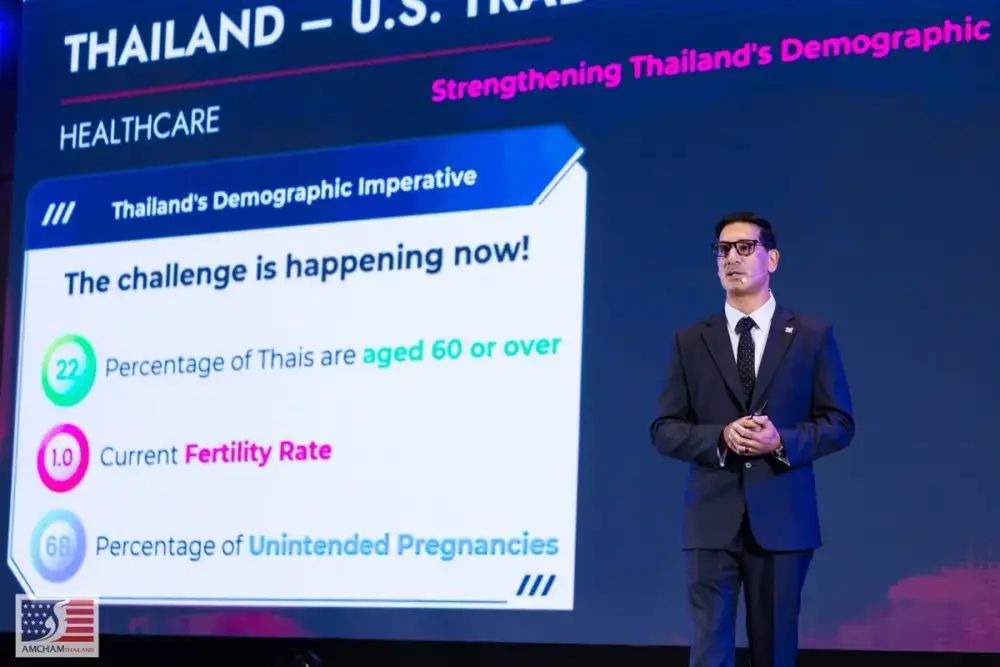
Ageing population, ultra-low fertility and high teen unintended pregnancy rates reinforce Organon's call for greater investment in women's health to support Thailand's future workforce and economic resilience.
Thailand's ageing population, record-low fertility rate and high teen unintended pregnancy rates are emerging as significant economic challenges, underscoring the need for greater investment in women's health as part of the country's long-term competitiveness strategy, according to Organon Thailand Lead Mo Yasin.

Speaking at the AMCHAM Thailand-U.S. Trade & Investment Summit 2026, which was co-hosted by AMCHAM Thailand, the Thai Chamber of Commerce, and the U.S. Chamber of Commerce, Yasin said women's health should be recognized not only as a healthcare priority, but as a strategic investment in workforce sustainability, productivity and economic resilience.
Thailand's demographic transition is accelerating. More than 22% of the population is aged 60 years or older, the country's fertility rate has fallen to approximately 1.0 child per woman, and annual births have fallen below 500,000 for the first time in modern history. Data cited from the United Nations Population Fund and Thailand's Department of Health also shows that an estimated 68% of teen pregnancies in Thailand are unintended, with approximately 64% of those unintended pregnancies not resulting in a live birth.
"These are not simply demographic statistics. They are economic signals," said Yasin. "A shrinking workforce affects productivity, competitiveness and investment. And investment shapes Thailand's future growth."
Yasin said Thailand has already demonstrated what strong leadership in family planning and reproductive health can achieve, but the country now faces a more complex challenge: reducing unintended pregnancies, especially among adolescents, while also addressing ultra-low fertility.
"The issue is not that people do not want families," said Yasin. "Many simply feel they do not have the support to build the families they want. The question we need to address is: how do we ensure every pregnancy is planned, wanted and supported?"
Yasin said policies that support women's health, family planning, fertility care, childcare and workforce participation should be viewed as investments in Thailand's future economic performance.
"Supporting women's health is not simply health policy," he said. "It is an investment in Thailand's future workforce, economic performance and competitiveness."
Yasin pointed to APEC Smart Families as an example of how partnership can translate policy ambition into practical systems. The public-private collaboration, led by Thailand's Ministry of Public Health, brings together governments, experts, academia, community organizations and industry to support reproductive choice and strengthen demographic resilience.
Started in Thailand, APEC Smart Families now spans all 21 APEC economies, representing more than 1.4 billion women across the Asia-Pacific region, many of which face similar challenges related to declining fertility, ageing populations and unintended pregnancy. Organon is proud to support the initiative as the lead private-sector partner.
"Partnership is where policy ambition becomes practical impact," said Yasin. "By working across government, healthcare, community partners and the private sector, we can help people live healthier lives and make informed choices throughout every stage of life."
Yasin said Thailand has an opportunity to become a global example of how women's health, demographic resilience and economic development can advance together.
"The challenge is clear, the evidence is compelling and the opportunity is now," said Yasin.