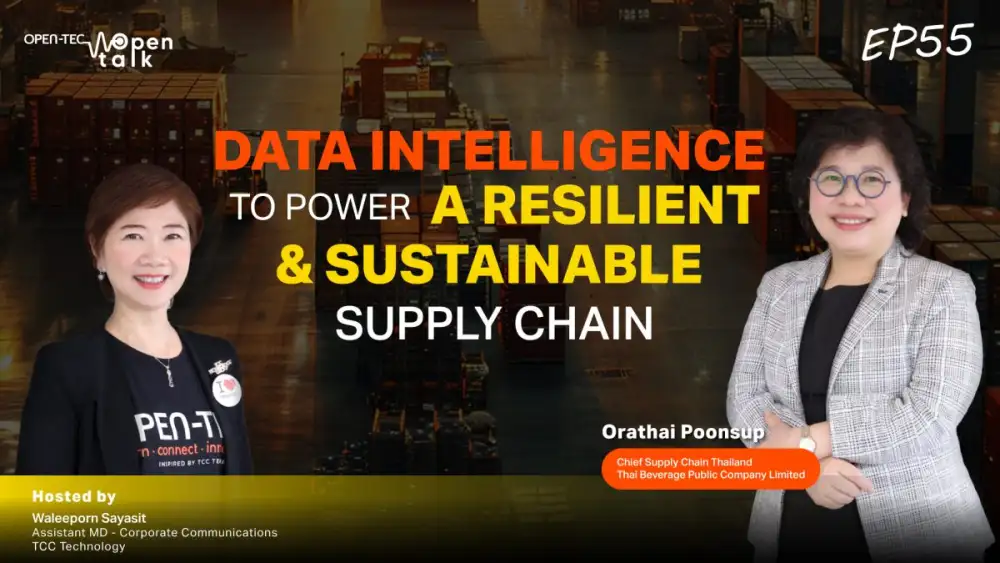
Recently, OPEN-TEC, a Tech Knowledge Sharing Platform, powered by TCC Technology Group, hosted a special "opentalk" session to explore how supply chain transformation through technology and data can serve as a key driver of operational excellence, and long-term business value and sustainability. The session featured Ms. Orathai Poonsup, Chief of Supply Chain Thailand at Thai Beverage Public Company Limited (ThaiBev), who shared her vision and experience in managing complex supply chain operations. She also highlighted strategies for advancing sustainability and the circular economy through the application of digital technologies and innovation, in collaboration with TCC Technology (TCCtech) and CMKL University.
Key Driver behind the Supply Chain Transformation
It was a valuable opportunity to gain insights from Ms. Orathai Poonsup, who oversees ThaiBev's end-to-end supply chain, from procurement and production to distribution. A key differentiator of ThaiBev's supply chain is its "Packaging Circularity" approach, which focuses on reusing and recycling packaging after consumption. The supply chain is structured into four core components: procurement, production, circular packaging management, and waste management. These elements are seamlessly interconnected, forming the foundation of a strategy that drives sustainability across the organization. This success is further strengthened by close collaboration with TCC Technology (TCCtech), providing planning and advisory support in various technologies and innovations to enable efficient operations.
Supply Chain Goals: Toward Net Zero and Circularity
ThaiBev's supply chain strategy aligns closely with global sustainability goals, particularly in reducing carbon emissions. One of the key challenges lies in managing emissions from more than 3,000 suppliers. Addressing this requires strong collaboration, oversight, and full visibility across the value chain.
At the same time, ThaiBev aims to increase renewable energy usage to 50% by 2030, with current progress at approximately 40%. Another major goal is achieving 100% packaging circularity by 2030, aligned with Extended Producer Responsibility (EPR) principles. This reflects a shift in the role of producers, from focusing solely on production to taking full responsibility for post-consumption impact.
Ms. Orathai also highlighted the importance of leveraging existing local systems. For example, the term "Saleng" refers to a long-established informal waste collection system. It operates as a decentralized network that supports waste management by collecting and sorting materials, enabling recyclables to be recovered from what would otherwise be discarded.
Data as the Backbone of Operations
To achieve these goals, digital technology plays a critical role, with data becoming the foundation of decision-making and operational efficiency. Ms. Orathai mentioned that through collaboration with TCC Technology (TCCtech), dashboards and digital tracking systems have been developed to monitor the efficiency of renewable energy usage in more than 40 factories nationwide. Sensors and analytics provide real-time visibility into system performance, enabling teams to quickly detect and address issues, including integrated technology platforms that connect fragmented data across systems into centralized. This integration maximizes the value of investments in clean energy and infrastructure, while supporting the organization's long-term net-zero ambitions.
The "Triple O" Innovation: Data, Robotics, and AI in Action
"Triple O" is one of the outstanding innovations in managing circular packaging at a large-scale activity, with nearly a million tons of glass and two hundred thousand tons of pieces of paper are recycled per year.
Oasis - Data-Driven Precision
The first "O," Oasis, is like pouring water into a desertalthough the selling locations are known, it is unknown where the remaining materials go after consumption. Therefore, technology and GPS data are used for analysis and matching to identify white space between shops and selling locations. From the insights gained, the team can identify sales volume and packaging return quantities, and implement appropriate and targeted management measures for each location.
Octopus - Robotics
The second "O," Octopus, resembles the tentacles of a giant octopus. It involves the use of specially designed articulated robot, different from general machines. This system is designed to support sorting of diverse and complex materials, improving management efficiency, reducing labor burden, and making work more convenient for people.
Oracle - AI-Powered Intelligence
The third "O," Oracle, is named after ancient Greek, referring to one who can accurately predict future events.
Here, it refers to the use of image recognition technology, an artificial intelligence (AI) technology that can recognize, analyze, and understand, enabling accurate sorting and classification of used bottles even in real-world conditions with varied shapes. This reduces material loss and increases the potential for maximum reuse.
This step is considered an important milestone in applying AI, developed by ThaiBev together with partners including TCC Technology and CMKL University. This project reflects that such innovation partners can help address business challenges into scalable digital solutions at the organizational level.
Circular Economy: Creating Impact on Society at Large
ThaiBev's circular economy model creates broad positive impacts on society. It supports over 3,000-4,000 partners and approximately 100,000 individuals, including recyclers, collectors, and small business operators.
For many, this ecosystem provides stable income and strengthens local economies. Environmentally, reuse and recycling reduce the need for raw materials and energy consumption. For example, reusing glass bottles helps conserve natural resources and lower carbon emissions. Additionally, production waste is transformed into renewable energy and agricultural inputs, reinforcing a fully integrated circular system.
The "Samui Model" is a strong example of process innovation, designed to address logistical challenges in island areas. By leveraging return logistics, using empty delivery trucks to transport recyclable materials back to the mainland, the company significantly reduces transportation costs while improving collection efficiency. Supported by data and coordination systems, this model demonstrates how process optimization can unlock new value without heavy infrastructure investment. It has already been expanded to multiple islands and continues to scale nationwide, delivering both environmental and community benefits.
Embracing the Future of Digital Supply Chain
In closing, Ms. Orathai emphasized that while technology and data are essential, true success lies in how organizations apply them. It requires the right people, the right mindset, and the ability to translate data into meaningful action. Technology must align with business objectives and strategic direction to create sustainable value. In today's rapidly evolving world, organizations that effectively embrace digital transformation will be better positioned to navigate complexity, drive innovation, and build a more sustainable future.
Source: opentalk EP. 55
Short Video: https://youtu.be/tnp75VIawx0?si=Hv7tBt7ObeUXYtDT
Full Video: https://www.youtube.com/watch?v=U39WJ1dvr-w