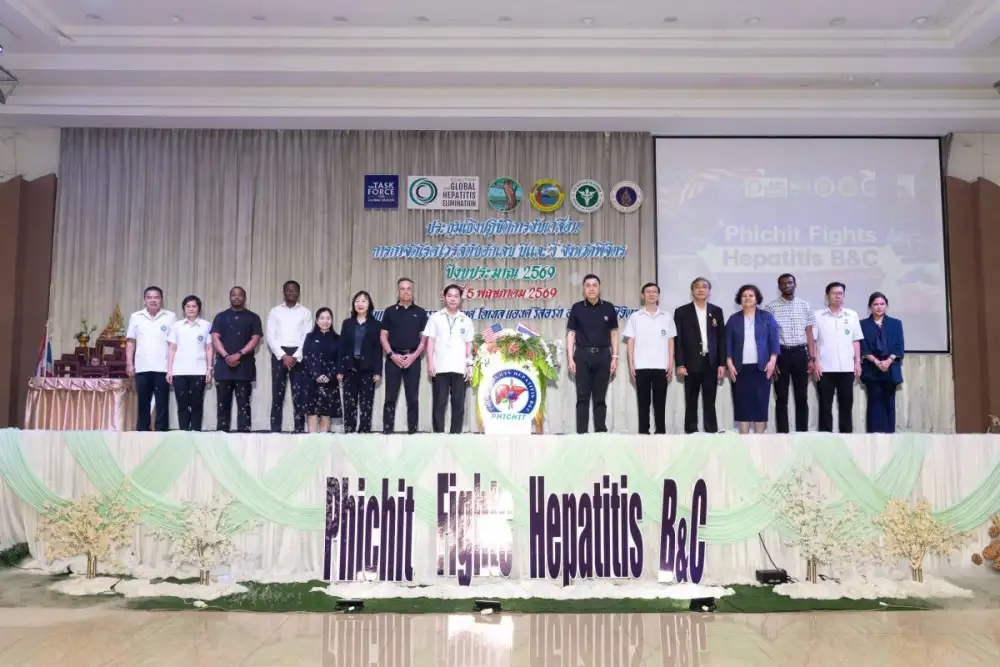
Roche Diagnostics joins as a key strategic collaborator in a multi-sectoral partnership led by The Task Force for Global Health and The Liver Foundation of Thailand; deploys WHO 2024 Simplified Linkage to Care and Thai-B technology to ensure no patient falls through the cracks between diagnosis and treatment.
Phichit Province has officially launched the "Phichit Model," a landmark public health initiative positioned as a national prototype for Thailand and an emerging global benchmark for the elimination of viral hepatitis B (HBV) and C (HCV).

Announced jointly by the Coalition for Global Hepatitis Elimination at The Task Force for Global Health and The Liver Foundation of Thailand, in collaboration with the Phichit Provincial Public Health Office, the Ministry of Public Health, the Government Pharmaceutical Organization (GPO), and Roche Diagnostics as a key strategic collaborator, the project aims to screen 100% of the 238,716 Phichit residents born before 1992 by the year 2028, ensuring that every person who tests positive enters and remains in care.
Liver cancer is the leading cause of cancer-related deaths in Thailand, and the number one cause of cancer mortality in Phichit Province. More than 80 percent of liver cancers are caused by chronic infection with hepatitis B or C viruses that progress silently for decades before symptoms appear.
"Plugging the Leaks": A Revolutionary Approach to Linkage of Care
At the heart of the Phichit Model is a determination to eliminate the "leaks" in the patient journey from screening to treatment. Nationally, only about half of HBV-positive patients successfully enter treatment after diagnosis a system-level breakdown the project is designed to correct. The effort is part of the Coalition for Global Hepatitis Elimination's Center for Operational Research on Hepatitis B (COR-HEPB).
The Phichit Model deploys the WHO 2024 Simplified Linkage to Care guidelines together with the Thai-B digital health information system to ensure that every patient who tests positive is identified, evaluated, and started on treatment. By using simplified APRI (AST to Platelet Ratio Index) based eligibility criteria, clinicians can begin antiviral treatment efficiently, shortening the path from screening to therapy.
"Every step of the traditional care pathway is where we lose patients. The Phichit Model is designed to close every gap, from the first finger-prick at a sub-district health post to lifelong follow-up, so that no one who needs treatment is left behind," said Professor Tawesak Tanwandee, M.D., Secretary-General, The Liver Foundation of Thailand.
Hepatitis Care is Liver Cancer Prevention
Chronic hepatitis B is the silent killer behind Thailand's liver cancer epidemic. Most patients have no symptoms until cirrhosis or cancer has already developed, and many learn of the infection only when it is too late. The medical evidence, however, is overwhelming: consistent antiviral treatment for chronic hepatitis B reduces the risk of developing liver cancer by up to 80 percent. For hepatitis C, a 12-week oral cure with a 99.8 percent success rate provided locally by the Government Pharmaceutical Organization can prevent liver cancer entirely when delivered before cirrhosis develops.
"A person with high blood pressure takes medication for life to prevent stroke. A person with chronic hepatitis B takes one pill a day to prevent liver cancer, and the impact on survival is far greater. Hepatitis treatment is, in real terms, cancer prevention medicine," confirmed Professor Tanwandee.
A Global Prototype, Driven by Local Heroes
What distinguishes the Phichit Model is not its technology or its funding, but its people. The project's success rests on the frontline network of village health volunteers, community nurses, sub-district health staff, district hospital teams, and provincial specialists who together form a continuous lifeline of care for every patient identified.
"Phichit Province is a global changemaker. Around the world, 250 million people are living with hepatitis B, and most are undiagnosed and slowly progressing toward liver cancer," said John W. Ward, M.D., Director, Coalition for Global Hepatitis Elimination. "There are very few operational research studies anywhere that test a simple, scalable model of care like this one. The lessons we learn in Phichit will help save lives in every country working toward the WHO 2030 elimination goal"
Roche Diagnostics: Enhancing Screening Through Strategic Support
As a key strategic collaborator, Roche Diagnostics provides the diagnostic support that helps power the active screening initiative in Phichit. This includes providing reagents for HBV viral load quantification, quantitative HBsAg testing, and other markers central to the project's comprehensive diagnostic panel.
While some diagnostic components are available through routine services, Roche's strategic support specifically enhances the availability of advanced testing markerssuch as viral load and quantitative HBsAgat the local level. This removes a critical barrier to accurate diagnosis and timely treatment decisions, enabling the Phichit Model to operate at the scale and speed required to reach more than 238,000 residents by 2028.
"At Roche Diagnostics, we believe that true innovation lies not just in developing advanced technology, but also in ensuring it reaches the communities that need it most. We are incredibly proud to serve as a strategic partner in the Phichit Model for Hepatitis B and C elimination, working alongside esteemed clinicians and facilitators to build a seamless, scalable and impactful diagnostic framework. By expanding access to critical diagnostic markers at the local level, we are helping to dismantle systemic barriers, empower patients with early detection, and ultimately transition liver cancer from a leading cause of mortality into a preventable disease." said Mihai Irimescu, General Manager of Roche Diagnostics Thailand.
The Phichit Model is now actively underway across all 12 hospitals in the province and at sub-district health-promoting hospitals in every district. Screening and treatment are fully covered with no out-of-pocket costs for the patient.
If you were born before 1992, join the Phichit Model. Screen for Free. Treat for Free. Protect your liver today to secure your future tomorrow. Residents with a family history of liver cancer, cirrhosis, or hepatitis are especially encouraged to come forward, regardless of birth year.
Links to videos:
https://youtu.be/ARzwBlmH2J4
https://youtu.be/p3NqbAABa78